Shocking Stat
~5 g / week
A landmark analysis led by the University of Newcastle for WWF estimated that people may ingest roughly 5 grams of plastic per week—about the mass of a credit card—from food, water, and air combined. Drinking water is one important piece of that puzzle.
What Are Microplastics?
Microplastics are plastic fragments smaller than 5 mm. They include:
- Primary microplastics — manufactured small, such as microbeads in cosmetics (now restricted in many regions) and plastic pellets.
- Secondary microplastics — broken down from bags, tyres, synthetic textiles, packaging, and marine debris.
They carry additives, can adsorb other pollutants, and vary in shape, polymer type, and size—including nanoplastics that raise additional biological questions.
Because they are invisible at a glance and do not change the taste of water, microplastics are easy to ignore—until you look at what the instruments are finding.
How They Reach Australian Tap Water
Australia’s water is treated to high microbiological standards, but microplastics are not yet a routine regulated parameter everywhere. Common pathways into municipal supplies include:
PATHWAYS INTO THE SUPPLY
Stormwater & runoff
Road dust, tyre wear, and litter wash toward catchments and intakes.
Treatment limitations
Coagulation and filtration target turbidity and pathogens—not all plastic sizes equally.
Distribution system
Aging pipes, gaskets, and maintenance activities can shed polymer particles.
Indoor plumbing
Flexible hoses and plastic fittings may contribute particles at the tap.
How Widespread Is the Problem?
Tap water studies using Raman spectroscopy and related methods have repeatedly found microplastics in treated municipal supplies. Multi-country surveys—including Australian samples—often report detection in more than 90% of samples, with some designs citing ~94%, depending on limits of detection and whether fibres vs fragments are counted.
That does not mean every glass is “full of plastic,” but it does mean absence of microplastics cannot be assumed from chlorine taste, clarity, or compliance with traditional water-quality parameters alone.
TAP WATER STUDIES
~94%
Positive detection rates reported in some aggregated municipal surveys (method-dependent).
BOTTLED VS TAP
2×
Bottled water often carries more microplastic particles per litre than tap in published comparisons.
Health Effects: What Science Suggests
Human evidence is still evolving, but animal and cell studies—plus knowledge of plastic additives—justify caution:
- Inflammation and oxidative stress — small particles may trigger immune responses when ingested or inhaled.
- Endocrine disruption — plastics and their additives can interfere with hormone signalling pathways.
- Particle transport — studies in model organisms have raised concerns about uptake and translocation, including discussion of whether very small particles could cross biological barriers; the blood–brain barrier is an active area of research.
Regulators stress dose, polymer type, and co-exposures. For households the practical takeaway is simple: reduce avoidable exposure—especially for vulnerable groups—while long-term risks are quantified.
Bottled Water Is Not the Escape
It is a common myth that bottled water is “cleaner.” Multiple peer-reviewed studies have found higher microplastic counts per litre in many bottled brands than in paired tap samples—often on the order of roughly two times or more, depending on brand, bottling process, cap shedding, and analytical method.
So switching from tap to single-use bottles does not reliably solve the microplastic problem—and it introduces cost, waste, and other chemical leaching concerns.
What Actually Removes Microplastics?
Particle removal depends on physical size exclusion and adsorption—not on boiling, which does not destroy plastic.
| Method | Typical microplastic removal | Notes |
|---|---|---|
| Reverse Osmosis (RO) | >99% | Membrane pores ~0.0001 μm block particles and dissolved ions. |
| Ultrafiltration (UF) | ~80% (varies) | Cuts larger particles; smaller fibres/nanoplastics may pass. |
| Activated carbon | Variable | Good for chlorine and some organics; not a reliable size barrier for all plastics. |
| Boiling | 0% | Heat does not remove solid plastic particles from water. |
Why RO Wins for Particles
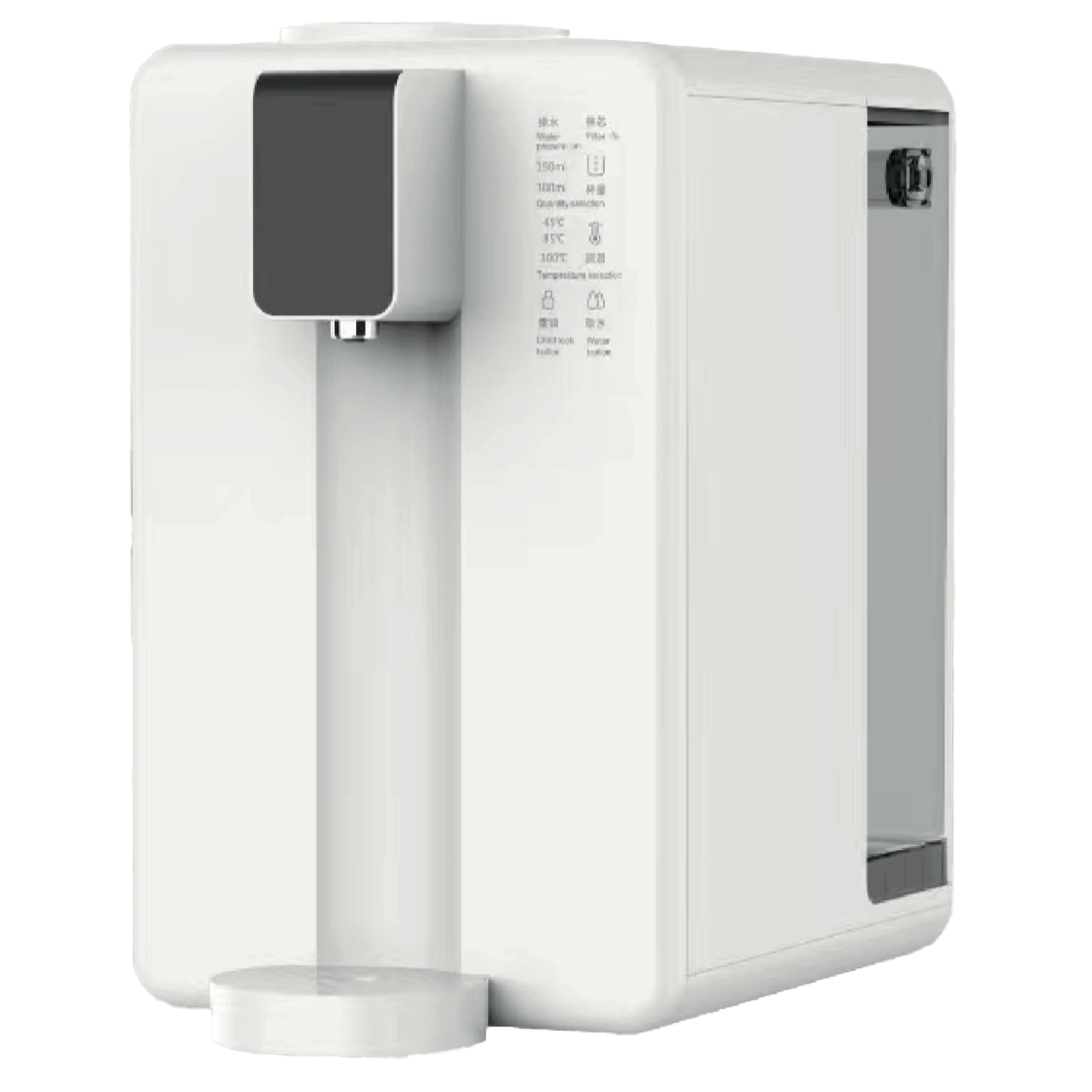
The MySea T1 RO membrane at 0.0001 μm blocks microplastics completely
Even fibres and fragments far smaller than 5 mm are still vastly larger than the passages in a high-quality RO membrane. Combined with carbon polishing and UV sterilisation, a countertop RO system gives you point-of-use control—independent of what enters the street mains that week.
A Sensible Home Strategy
You cannot micromanage every environmental source of plastic, but drinking and cooking water is one lever you can pull with high confidence:
- Prefer RO-filtered water for drinking, baby formula, and sensitive cooking.
- Keep single-use bottled water for emergencies or travel—not as a daily “microplastic fix.”
- Maintain filters on schedule so flow, rejection, and hygiene stay optimal.
The MySea T1 delivers 75G RO performance, UV tank protection, and instant hot water in a zero-installation countertop form—so you get serious particle exclusion without a plumber or permanent kitchen modifications.
Key specs:
- RO membrane rated at 0.0001 μm effective separation—microplastics physically excluded
- Built-in UV for stored water hygiene
- Multi-temperature dispensing for family routines
- RCM certified by TÜV Rheinland Australia
Interested in the MySea T1?
Five-star hotel water quality, right on your countertop. RCM Certified.
Share this article
Related Articles
The Complete Guide to Safe Water for Baby Formula in Australia
What water should you use for baby formula? Learn why paediatricians recommend purified water, the hidden risks in tap and bottled water, and how to prepare formula safely.
TravelWhy Hotel Water Isn't As Safe As You Think (And What to Do About It)
Old pipes, roof-top tanks, and Legionella — hotel water safety is a real concern for travellers in Australia and abroad. Here's what you need to know.